Algorithmic Trading and Current Market Landscape in India

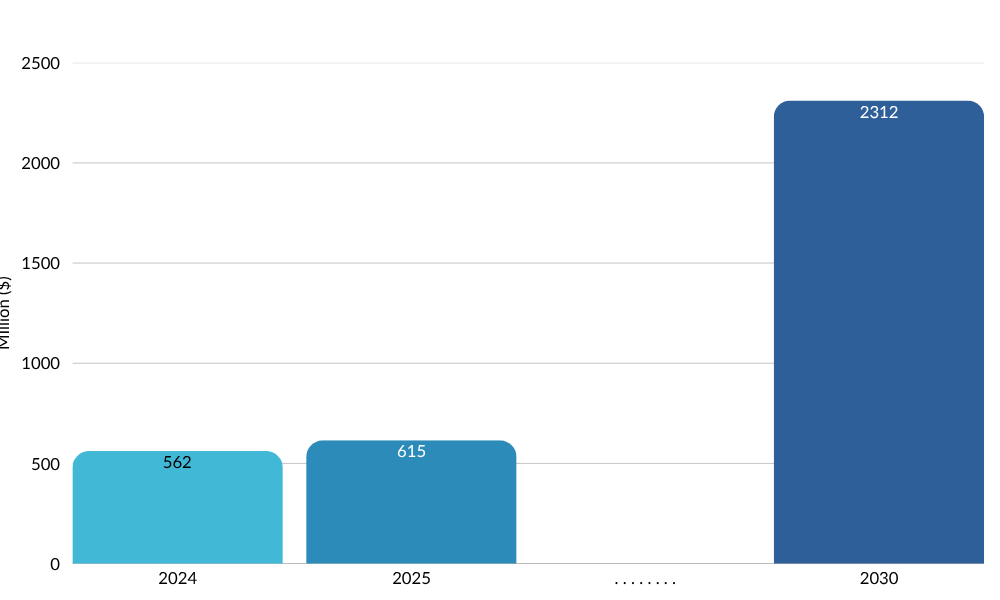
India’s financial markets are witnessing a major change as algorithmic trading reshapes the investment landscape. With over 60% of trades now automated and the market projected to grow from USD 562.20 million in 2024 to USD 1,274.48 million by 2033, India has emerged as a critical player in the global algorithmic trading ecosystem. This shift represents not just technological advancement but a fundamental reimagining of how Indians engage with capital markets.
The Current Market Dynamics
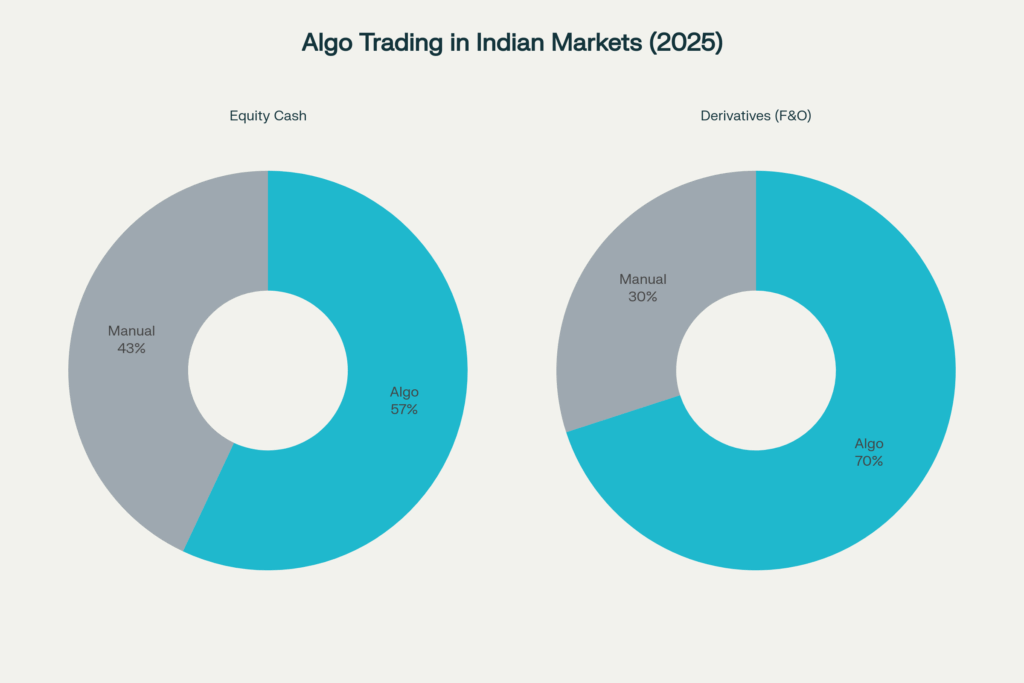
The scale of algorithmic trading adoption in India is remarkable. Recent data reveals that 57% of equity cash trades and 70% of derivatives trading volume are now executed through algorithms, demonstrating the technology’s deep penetration across market segments. This dominance has grown steadily from less than 50% just a couple of years ago, indicating rapid acceleration in adoption rates.
The institutional landscape tells a compelling story. Algorithmic trading constituted 97% of profits for foreign investors and 96% for proprietary traders in futures and options during fiscal year 2024. However, only 13% of the 95.7 lakh individual traders currently utilize algorithmic strategies, revealing a massive opportunity for retail participation growth.
Regulatory Framework Evolution
The regulatory landscape underwent a seismic shift with SEBI’s circular dated February 4, 2025, introducing the “Safer Participation of Retail Investors in Algorithmic Trading” framework. Originally scheduled for August 1, 2025, the implementation has been extended to April 1, 2026, providing brokers additional time for system upgrades and compliance preparations.
Key Regulatory Changes
The new framework introduces several critical requirements:
Unique Identification System: Every algorithmic order must carry an exchange-assigned unique identifier to establish comprehensive audit trails and enable real-time monitoring of trading activities.
API Authentication: Two-factor authentication (2FA) becomes mandatory for all API-based order placements, with static IP addresses required for API access. Retail users can provide a maximum of two static IPs mapped to their assigned API keys.
Algorithm Registration: Strategies exceeding 10 orders per second must be registered with exchanges, categorized into “White Box” (transparent logic) and “Black Box” (opaque logic) algorithms.
Broker Responsibility: Trading members assume full principal responsibility for all API orders, including client verification, complaint handling, and compliance monitoring.
Empanelment Requirements: Third-party algorithm providers must be empanelled with exchanges before offering services to retail investors, ensuring regulatory oversight over the entire ecosystem.
Technology Infrastructure and Platform Ecosystem
Institutional vs. Retail Participation
India’s algorithmic trading ecosystem has evolved into a sophisticated technology landscape. The National Stock Exchange (NSE) operates 219,015 trading terminals across the country, supported by high-speed networks and co-location facilities for institutional clients and sophisticated traders.
Leading Platform Providers
The Indian market features several prominent algorithmic trading platforms:
StockSenz emerges as a notable AI-driven algorithmic trading firm based in India, focusing specifically on empowering retail traders and investors in the listed derivatives market segment. The company leverages advanced AI-based algorithmic trading strategies with a mission to democratize access to sophisticated trading tools, helping individuals make data-driven decisions and optimize returns.
AlgoBulls leads with comprehensive solutions for retail traders, quants, and enterprises, offering regulatory-compliant infrastructure without server management complexity.
uTrade Algos provides 100% no-code visual strategy builders, enabling traders to create logic without programming knowledge while maintaining SEBI compliance.
The no-code algorithmic trading platforms market was valued at USD 4.9 billion in 2024, projected to grow at 38.2% annually through 2029, reaching USD 24.8 billion by 2029.
Institutional vs. Retail Participation
The participation divide between institutional and retail investors remains significant. While institutional adoption approaches saturation with major global trading firms establishing HFT desks in India for proprietary trading, retail participation lags considerably.
High-frequency trading (HFT) represents a growing segment, with market players seeking faster execution, reduced latency, and greater efficiency. Foreign Portfolio Investors (FPIs) generate 97% of their profits through algorithmic strategies, while proprietary traders achieve 96% of profits through automated systems. This stark contrast with the 13% retail participation rate underscores the untapped potential in democratizing algorithmic trading access.
Technology Infrastructure Demands
Cloud-based deployment dominates with 58.8% market share in 2025, driven by superior scalability requirements. As algorithmic strategies become more sophisticated, processing massive real-time data flows, cloud infrastructure enables instant scaling of computing power and storage capacity.
Artificial intelligence and machine learning integration transforms trading execution, enabling analysis of vast datasets including news sentiment, social media trends, and macroeconomic indicators for improved decision-making accuracy.
Growth Opportunities
Retail investor democratization represents the largest growth opportunity. With over 95 lakh individual traders in the Indian market but only 13% using algorithmic strategies, the potential for expansion is enormous.
Cross-asset expansion beyond equities into forex, commodities, and cryptocurrencies presents additional growth vectors. International market integration creates opportunities for cross-border trading and arbitrage strategies.
The fintech funding landscape supports this growth, with India’s fintech sector ranking third globally in 2025 funding, raising Rs. 7,593 crore (USD 889 million). Early-stage funding showed 10% growth, indicating sustained investor confidence in scalable, innovation-led models.
Future Outlook and Strategic Implications
Machine learning and Artificial Intelligence integration give trading platforms competitive advantages, while real-time backtesting capabilities provided by platforms like TradingView, enable strategy optimization before capital deployment. The convergence of AI, big data, and cloud computing creates unprecedented trading sophistication.
API-first infrastructure supports custom logic integration, while low-latency execution engines enable high-frequency trading capabilities previously exclusive to institutional players.
The shift from manual to automated trading represents fundamental market structure evolution. As retail participation increases through user-friendly platforms and regulatory clarity, market liquidity and efficiency should improve substantially.
Risk management sophistication increases through automated systems that eliminate emotional biases and implement consistent strategy execution. This evolution supports broader financial market stability while improving individual trading outcomes.
Conclusion
India’s algorithmic trading landscape stands at an inflection point. With market size projected to more than double by 2033 and regulatory frameworks providing unprecedented clarity and protection, the foundation for sustainable growth is firmly established. The 57% equity cash and 70% derivatives algorithmic penetration rates demonstrate technology adoption success, while the massive retail participation opportunity suggests the transformation has only begun.
Success in this evolving landscape requires balancing technological innovation with regulatory compliance, institutional efficiency with retail accessibility, and market growth with systemic stability. As SEBI’s framework becomes fully operational in April 2026, India’s algorithmic trading market is positioned to become a global benchmark for regulated, inclusive, and technologically advanced financial market infrastructure.
The journey from manual to algorithmic trading represents more than technological upgrade—it embodies India’s broader digital transformation and financial market maturation. With proper execution, this evolution will democratize sophisticated trading strategies, improve market efficiency, and establish India as a global leader in financial technology innovation.